So many of my short stories begin by posing the question, what if?
What if you dreamed somebody else’s dream? Blend that with a thought of, instead of being the housewife of an astronaut, Samantha from Bewitched had a regular job, working in a coffee shop? What if she had a dream that was somebody else’s dream? What if the coffee shop comprised a cast of characters, like the bar in Cheers?
That was the formula behind my short story, Dreamscape. Now, here is the rest of the story …
The Daytona Fiction Writer’s group started decades ago. Before I joined, I had only written a few non-fiction books. The fiction short story, Dreamscape, was among the first of my submissions to the group. It was well-received, so I came up with a sequel, and tentatively tagged the series Coffee Plots, suggested by the coffee shop setting and my penchant for a play on words. The coffee shop would grow to have a cast of characters, like the TV show Cheers.
From there I created several more stories, incorporating characters that included the original three, Samantha and Georgiana, the television field reporter, along with police Detective Johnson, followed by two part-time employees, David and Sandra, and Margaret, the manager. That provided a platform for developing plots involving combinations of the characters and customers.
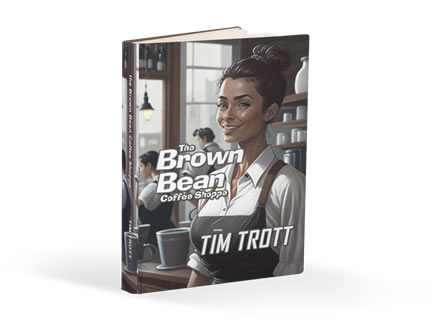
When I thought I had enough for a short story collection, I self-published it with the title “The Brown Bean Coffee Shoppe.” I adopted the classic spelling of “shoppe” to distinguish the fictional setting from all the real Brown Bean coffee shops.
When I thought I had enough for a short story collection, I self-published it with the title “The Brown Bean Coffee Shoppe.” I adopted the classic spelling of “shoppe” to distinguish the fictional setting from all the real Brown Bean coffee shops.
Then I discovered an unexpected problem: coffee pots are not a book genre. Amazon searches for the title grouped the book with kitchen utensils. By then, I also had several more stories for the series. I took in the big picture, and decided on a name that would better depict the theme of the book about a barista with secret psychic powers. There it was: The Psychic Barista, now with a new, more dynamic cover, keeping the coffee theme but leaving out the coffee shop background. – Get it FREE on Kindle Unlimited or BUY it HERE.
More stories will follow the original collection, to be contained in a second publication, Book 2.

I need to express my appreciation to several certain members of the Daytona Fiction Writers, beginning with Veronica Helen Hart. At my first meeting, I expressed concern I would not fit in because I could not write fiction. “Ronnie” looked at me, almost sternly, and challenged me by saying “Yes, you can.” So I did! Who was I to contradict a well-established, traditionally published author? (Silent Autumn, Annie Karenina: A Master’s Reimagined Story, The Reluctant Daughters, and so many others).
It was another member, Chris Holmes, who suggested I expand the original “coffee-plots” stories into a series. So, I did.
I am convinced writers’ group provides a wide range of resources. In our group, one member is involved in law enforcement, and is quick to define the requirements for “probable cause” in a crime fiction plot. Chris is a graphic artist who designs book covers. Another member has published over fifty historical novels, and one is an editor. In any group, each member provides a different perspective in their writing submissions and critiques.
My strong recommendation to any author is to find and join a writers’ group, whether it meets locally at your library or online in a Zoom call. Interacting directly with other writers and their views on your writing is incredibly valuable for any writer. A dozen of your peers offering a variety of perspectives is not a substitute for a good editor, but it is just as indispensable.
I hope you enjoyed this behind-the-scenes look at the creation of my Psychic Barista short stories.